

With the release of Dune: Part Two, I figured it’s high time we discuss the various aspects of my chief sci-fi obsession: All things Dune-iverse.
There are spoilers in this post, so get reading and watching if that bothers you.
The Spice Must Flow by Ryan Britt
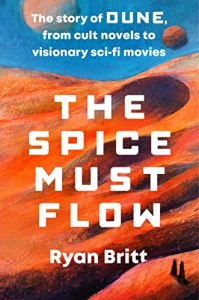
Earlier this year, I picked up a book called The Spice Must Flow: The Story of Dune, from Cult Novels to Visionary Sci-Fi Movies by Ryan Britt. Yes, the idea of reading Timothée Chalamet‘s take on the Dune books and movies swayed me probably too much in my decision to purchase it (he is quoted a few times, but not much, so if you’re only into Dune for Timmy, it won’t be worth your while). But, I actually really enjoyed all the trivia in the book (especially the origin story of Dune and its rocky path to publication), and it motivated me to finally watch the OG 1984 movie version of Dune, as well as the 2000s Sci Fi Channel miniseries, Frank Herbert’s Dune and Children of Dune (which actually starts with Dune Messiah, which kind of makes sense since the first and third books are both twice as long as the second in the series). I was even thinking of reading some of the follow-up books written by Frank’s son Brian, but after hearing a guy at the Dune: Part Two premiere say to his fellow moviegoer, “his son wrote like 30 more and they’re all terrible,” I decided against it.
This was my Goodreads review of The Spice Must Flow, posted at the end of January 2024:
I learned a lot about Dune! But, a few sections were a little dry (no pun intended) or eye-rolly. I’d also hoped for more interviews with the cast, though I realized by the end it probably wasn’t necessary. Still, an interesting read if you’re into more than just the first book or the new movie.
Dune by Frank Herbert
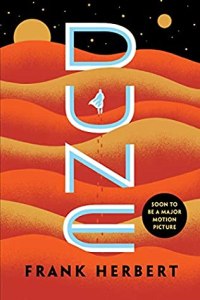
Unlike most Dune nerds (which I prefer to the term “geek,” though not strongly) I read the first book for the first time just a few months before the 2021 movie came out. As an English major, and something of a “purist” at the time, I only read it to prep myself for the movie, thinking the source material was always king. It’s possible I attempted reading the book in high school, but I only have a vague memory of that, and I don’t think that was the right time for me to read it; I was sort of prejudiced against sci-fi back then for some reason.
Fast forward to November 15, 2020, and this was my Goodreads review:
Immersive. Innovative. Captivating. Right now, this feels like the best book I have ever read. I’m not kidding. The story itself is second to none. I could not put down this book and I can’t believe I’ve never read the sequels. The only thing I can figure is that I was not prepared for this novel when I first read it. Frank Herbert was a genius, and I can’t wait to read the next book (or see the new movie)!
While it’s true I still love the book, as I’ve delved more into the world of screenwriting for my MFA program, I’ve realized that I am definitely not always (or even often) in the “the book was better” camp, and I recognize that a good adaptation is one that makes changes that serve the cinematic experience and the core elements of the story, and those core elements may not be found in the plot. That’s a discussion for another time.
Dune Messiah by Frank Herbert

What’s really interesting about the second book in the series is that it turns our hero into something of a villain, though that label still seems a bit too strong to me. What’s amazing is that Herbert is able to achieve this in a completely believable (and heartbreaking) way, though a lot of people hated it at the time, and many still do, I hear. This is where I have to disagree with people like Britt who say “Dune Messiah is nobody’s favorite Dune book” (83). While, yes, the first book is still my favorite, Messiah is only second because it could not exist without Dune. The boldness with which Herbert pushes the hero’s journey into its actually historically accurate villain era spiral was unparalleled at the time, maybe still is, especially in Sci-Fi (though I still can’t claim to have read an acceptable sample size of books in the genre).
Here was my Goodreads review, posted Dec. 4, 2020:
SO. EFFING. GOOD. Anyone who says otherwise is wrong and didn’t “get” the series.
Short but uh, sweet, eh? Ha.
Children of Dune by Frank Herbert
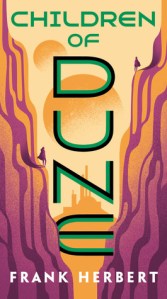
The third book in the series is pretty out there (e.g. Paul’s sister is possessed by the dead Baron Harkonnen, and Paul’s son begins his transformation to the eternal worm-man hybrid), but I still loved it. I was riding the Frank Herbert high when I wrote my review for Children of Dune on the last day of 2020:
Frank Herbert was a genius. Maybe he’d hate me saying so, but his writing talent and skill are unparalleled. It took me a while to get into this book (in part because I was sneaking reads before I could take it home), and I even resisted the narrative at parts, but in the end this book, like the others before it, is an unmatched work of art/philosophy/entertainment. I’m still in awe, and I wish I could’ve met the author. If only I’d discovered (and been able to appreciate) this series sooner!
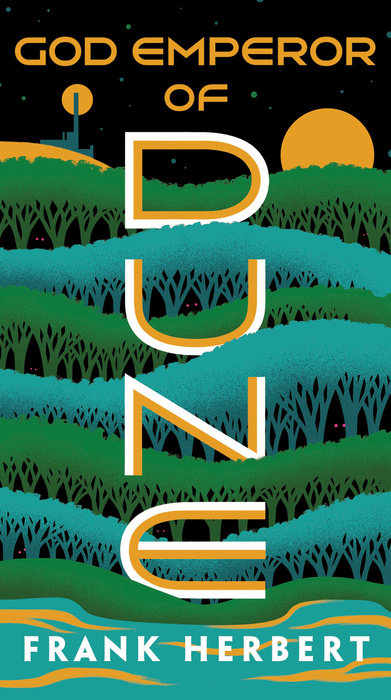
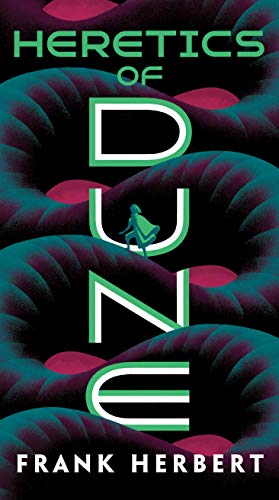
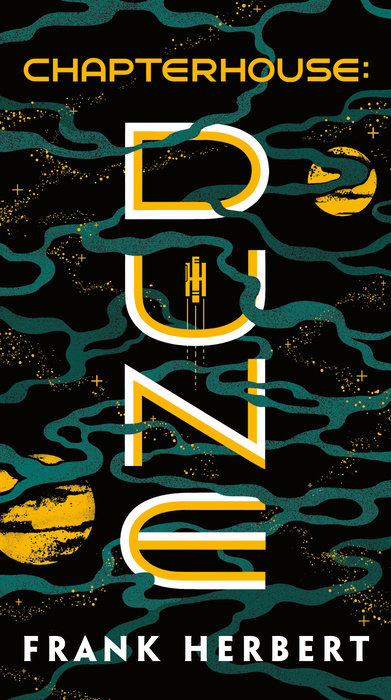
God Emperor of Dune, Heretics of Dune, and Chapterhouse: Dune by Frank Herbert
Books 4, 5, and 6 of Herbert’s Dune series left much more to be desired, and honestly, it’s probably because a) Paul Atreides was long dead, and his son had lost his humanity, b) Herbert hadn’t planned a hexology from the start, and c) he had a lot going on in his personal life. Britt calls this second trilogy “the most confidently bonkers sequels in any fiction series ever,” which Herbert only wrote because Children of Dune was such a success and Dune had been optioned to be made into a movie, which, you guessed it, made him a lot of money (175). God Emperor of Dune—which Britt calls “structurally…bananas”—came out in 1981, which is when Herbert met his second wife-to-be. Maybe there was nothing there at the time, but his first wife had already been ill with lung cancer for years, and after she died in 1984 (the year Heretics came out), he married this woman he’d met in ’81. So, maybe his focus wasn’t as much on the story as it could’ve been, who knows. Then he got sick and died less than a year after Chapterhouse was published.
I didn’t write reviews for books 4 and 5, which I remember as being OK, but not really what I was hoping for (according to Goodreads, it took me 3.4 and 2.4 months to read each, respectively). This is all I wrote for book 6:
Oof. That took me months to finish.
(Six, to be exact.)
Dune by David Lynch

The worst part of this movie was the “voice cannons” for sure, followed by the boxy “shields.” Re: voice cannons, apparently the moviemakers or marketing people didn’t think viewers could understand something as subtle and “nuanced” as manipulation by voice (“these aren’t the droids you’re looking for,” anyone?) without turning it into a literal physical weapon (to be wielded by any willing Fremen, no less, not just the select trained by the Bene Gesserit). As for the shields, CGI had yet to advance, but the choice they made there was AWFUL. Also, there were a heck ton more white people in this movie than there should’ve been, even considering the era, I think. And there was too many info dumps via voiceover that just weren’t necessary. Plus, MacLachlan seemed way too old to be Paul (though he, like Timmy, had great hair, and was actually younger than Chalamet was when he started filming Dune).
Both as an adaptation and as a movie on its own, I don’t think I can give this version of Dune more than one star. But maybe you had to be there.
Dune and Children of Dune miniseries
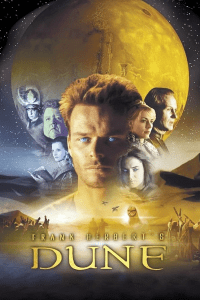
Unlike the 1984 film, the Sci-Fi Channel miniseries definitely delivered, despite their clearly low budget. Some have called this the most faithful adaptation of the series, and for the most part, I agree, though it’s hard to get past the bad CGI. The main inaccuracy in my mind was the portrayal of Jessica, though that seems to be a struggle for every actress who has played her. Mostly she seemed too weak, I think.
The best thing about this adaptation is that they preserved the dinner scene where Paul throws down with his father’s guests. The little Alia was also pretty good, even though her speech was dubbed over by an older actress. And the actress who played Chani at least had more the appearance and demeanor that one would expect, based on the source material.
Dune by Denis Villeneuve

Great movie. Pacing was on point, “the voice” was super cool, and the casting was excellent. Brolin’s choices as Gurney in the training scene with Paul were weird, and pulled me out of the movie for a moment, but their fight sequence (and the one with Jamis, and others), were really well done.
Sadly, they left out the dinner scene, but I get it.
Another difference is that Liet Kynes is female in this version of the story, which to me is not actually a significant change, but a smart one; thematically, it maybe makes more sense to make the planet ecologist a “mother” figure to Arrakis (though there’s much about this version of Liet that is still very masculine), and showing more female characters in positions of power is culturally in line with the Fremen understanding of gender equality, which Herbert set up but didn’t always follow through on in the first few books.
Also, Hans Zimmer killed it on the soundtrack. And if you read Britt’s book, particularly the chapter(s) that detail the history of directors attached to Dune projects, you’ll see the timing was perfect for a passionate filmmaker and fan like Villeneuve to take this on.

Dune: Part Two by Denis Villeneuve
Even more amazing than the first? Yeah, I think so, though it’s still a bit of a slow burn to get to the most epic moment, when Paul accepts his fate as the Lisan al-gaib.
Seriously, that five-minute scene that kicks off the third act at the 2-hour mark is a cinematic triumph and a master class in acting from Timothée. He said in an interview with Entertainment Weekly that he was super proud of that scene, as he should be. (It’s actually a very good article, which you can read here; it’s a crime that EW is no longer printing their magazine, especially because they got some great photos.)
Everyone’s been saying this movie is epic, and they’re not wrong. Still, there are some significant departures from the book:
- Chani does not see the reasoning behind Paul’s decision to become the Kwisatz Haderach, dethrone the emperor, marry Princess Irulan, and massacre millions in a holy war. She kind of hates Jessica from the beginning (because of what she represents as a member of the Bene Gesserit and what she encourages Paul to do), and she’s so upset by Paul’s decisions that she runs off into the desert to hail a sandworm at the end.
If you haven’t read the books (or maybe if you have and didn’t like them), this probably makes perfect sense. But it is a narrative change, which should make fans wonder how Paul, Irulan, and Chani will end up under the same roof, or how this Chani and Paul can reconcile enough to have children together. Nevertheless, it seems a smart change that gives Chani more depth and highlights the social and environmental justice issues at play, the critique of religion Herbert tried to convey. Plus it just heightens the drama. - Jessica seems to relish her position as Reverend Mother and the furtherance of Bene Gesserit ideals, and comes off as colder and perhaps more selfish than she does in the books. Again, it makes sense to make this change, because it raises the stakes and supports the intended critique of religion/religious figures. This Jessica also seems sort of pre-possessed by her unborn daughter (who is to become possessed by the dead Baron Harkonnen), which, while maybe a bit weird, works as an element of foreshadowing and underscores the danger of the influences the characters who drink the water of life take on. It shows us how powerful ideas can be.
- At the end of the movie, Alia isn’t born yet, so she doesn’t/can’t kill the Baron; that task falls to Paul, and honestly I’m OK with that too, because a) it’s not really her story yet, b) we can tell how dangerous she is already because of the way she “commands” Jessica, and c) it drives home the power of Muad’Dib. It’s funny that Alia actually seems more innocent when we see her in Paul’s vision as a quasi-adult, but that might actually be the point; false or not, it gives us hope that maybe she can be redeemed, despite being an “abomination” (which, by the way, is also a label bestowed upon Paul, rather than her, after he uses the Voice on the big bad Reverend Mother Gaius Helen Mohiam).
There are other differences—like the fact that it’s the Baron, not Thufir (who’s presumably just dead), who let’s an un-drugged “slave” into the gladiator pit with Feyd; that Paul doesn’t inherit Jamis’ wife and kids; and that there’s no Count Fenring, only the Lady Margot—but the changes to Chani and Jessica are the most significant, and as I said, they’re smart. The addition of Souhelia Yacoub’s character seemed kind of irrelevant to me, since she really only served as a sounding board/echo chamber for Chani, but I can see how it would be hard to convey as much of Chani’s thoughts and feelings without that.
Speaking of Chani, I don’t want to end this review without congratulating Timothée and Zendaya for being able to create a believable onscreen romance so quickly; Zendaya talks about how Denis would shoot just a bunch of glances between her and Timothée to get the right emotion at the right moments and it totally worked. The way they look at each other and the way they react in that final scene with the emperor is heart-wrenching—when Paul turns his back to Chani to fight Feyd (creating a perfect symmetry with Jessica warning him about who/what he turns his back to at the beginning of the film), when he tells her he loves her but then proposes to Irulan for political reasons, when Feyd comes between them… there is so much to love about this movie but that final sequence is second only to Paul’s transformation scene. The fight with Feyd, the silent demand for the throne… you can feel the adrenaline.
And I would be remiss if I didn’t at least mention the great comic relief from Stilgar! And the Star Wars callbacks (though if you read Britt’s book you’ll see just how much George Lucas owes Frank Herbert, creatively):
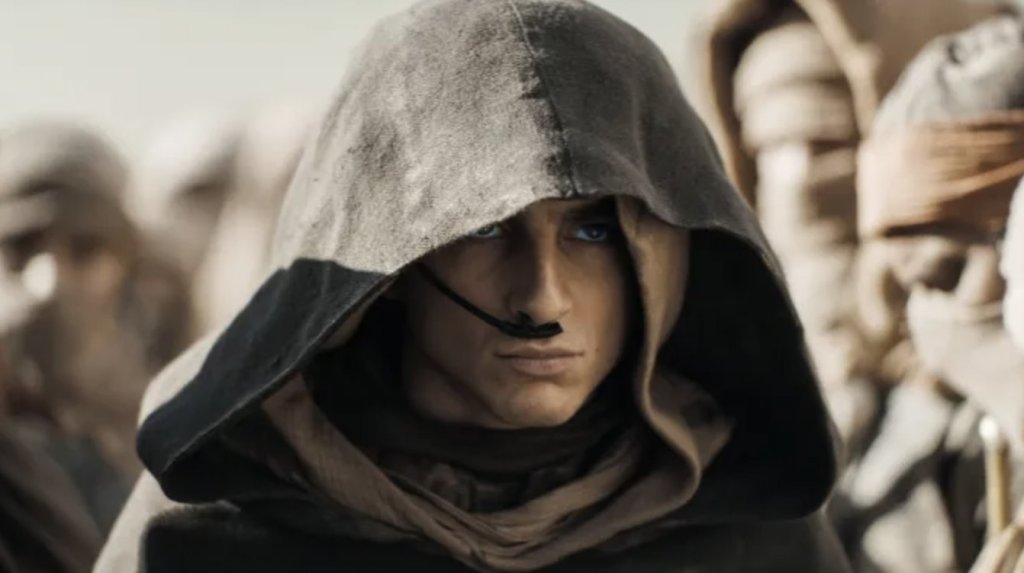

As you may have guessed, I could go on and on. Maybe more coherently than I have, but… even I get tired of hearing myself talk (and typing).
Anyway. You know what my rating is.
Go see Dune: Part Two in theaters as soon as you can. If you like movies, you won’t regret it. (I’ve already seen it twice—the first time in IMAX, #worth—and don’t be surprised if you see me in theaters a third time.)
Oh, and here’s a little bit of Dune silliness for you from the meme-y side of the internet.

 Caitlin M.S. Buxbaum
1 thought on “The Dune Post”